Use-wear analysis
Objects don't speak. It is not always immediately apparent how they were used or what purpose they served. This often requires a more detailed examination. Through detailed analysis, information can be gleaned even from the tiniest signs of wear, allowing the veil of time to be lifted just a little. In the case of the finds from the Bad Dürrenberg shamaness, Prof. Jörg Orschiedt looked for traces on the roe deer antler cap, amongst other things.
My name is Jörg Orschiedt, I am an archaeologist and anthropologist and work here as a consultant in anthropology. My daily work basically involves dealing with specific issues relating, as you might expect, to human skeletal remains. This can encompass a period ranging from the Stone Age, which includes older finds from the Stone Age, to medieval or modern finds.
For me, it's basically an archaeological and also materials science type of analysis that deals with objects, in this case of course from an archaeological context, where you try to find out how they were used, what was their function, how they were made, and, above all, of course, how long they were used. So, in principle, to put it very briefly, it's about reconstructing and presenting the history of an object.
Well, firstly, we have the traces of use by the living animal, in this case the roebuck itself, and then, of course, we find traces of the skinning or defleshing of the skull piece. Thus, we have incision marks where soft tissue or hide has been removed. And, of course, we also have the impact and fracture marks from breaking the pedicle out of the skull. In other words, the manufacturing marks.
And then comes the big question: how was it actually used? And here, too, we again have the problem that we don't really have any comparable pieces because we don't know exactly how she wore the piece.
There is no polish on the cranial piece itself, but there is on the antlers. It is very difficult to tell whether this polish came about during the animal's lifetime or afterwards. But what definitely happened afterwards and is related to the use of the piece are the cut marks on the antlers themselves, roughly at the height of the first tine. Where you can see that something was attached. There is also red ochre in this area.
Clearly, something has been manipulated here. It is not functional in the sense that one would say it has anything to do with the defleshing or the butchering of the animal. This doesn't make any sense here, as you don't need to cut on the antlers themselves. It must have something to do with function. It is entirely conceivable that something was attached to the two antler beams. Exactly how this looked is, of course, a matter of speculation.
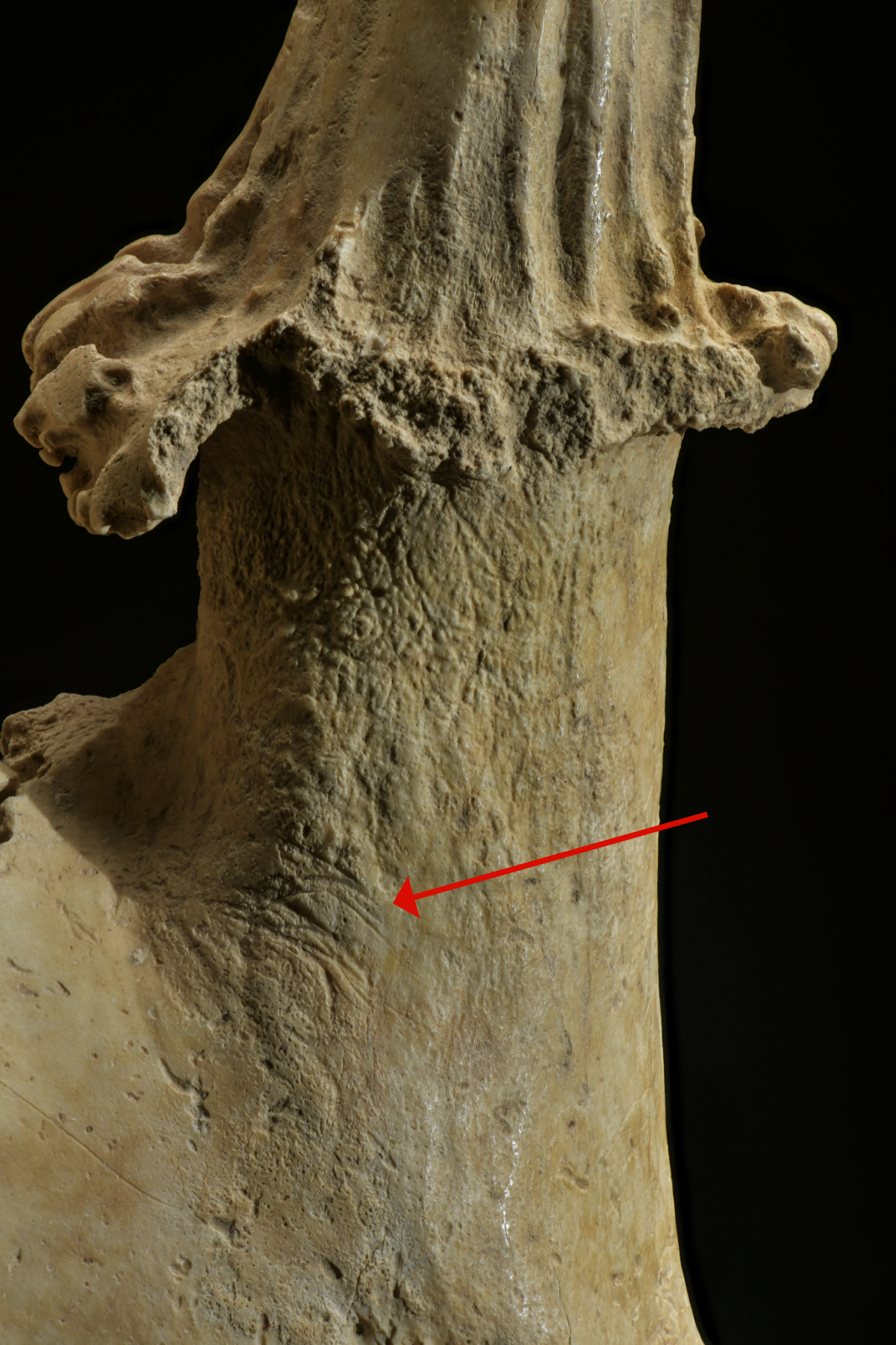
In the close-up, the fine cut marks on the skull bone below the base of the antlers are clearly visible. These have most likely been caused by the skinning and fleshing of the skull.
©LDA Sachsen-Anhalt, photo: Juraj Lipták
Now, these antler caps that we know from museums, which were also made from roebuck antlers and were sometimes worked into headgear, look remarkably similar to the one we have from the shamaness. And what is fascinating there, something I never really noticed before but which can actually be seen time and again, is that, interestingly, almost everywhere in the world where these pieces turn up, the animal's ears are also preserved. So, they tried to prepare these ears somehow, and they may have been tied to the antlers.
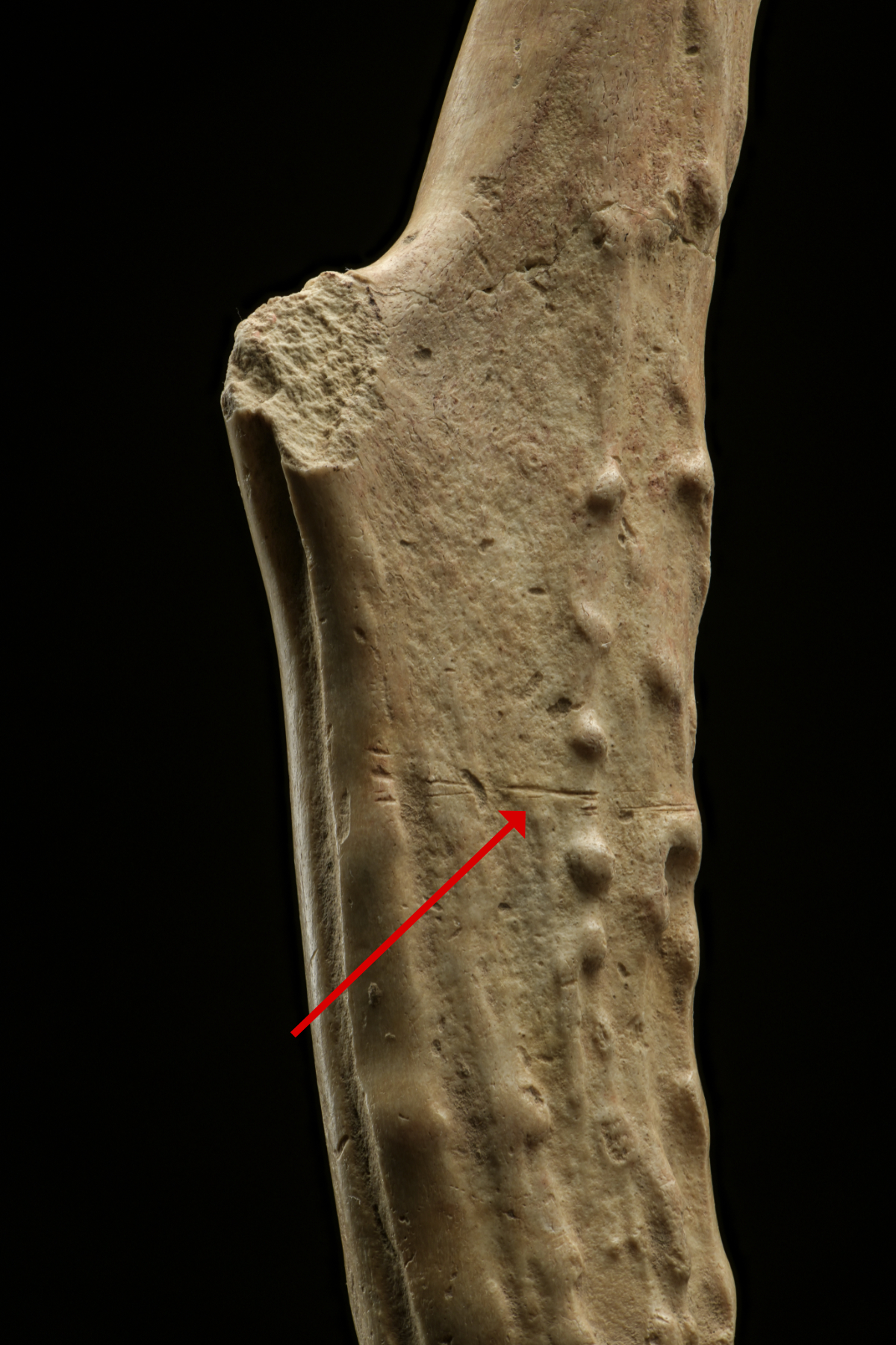
The beams of the antler show cuts that are likely due to other reasons: they may have been caused by the attachment of an object.
©LDA Sachsen-Anhalt, photo: Juraj Lipták