Anthropology: Skeleton of the shamaness
Our bones are with us throughout our entire lives. Like an archive, they store a vast amount of information. In addition to congenital characteristics, they contain traces that can reveal a person’s behaviour and lifestyle. Prof. Jörg Orschiedt has come to some facanating discoveries regarding the human remains of the shamaness.
My name is Jörg Orschiedt, I am an archaeologist and anthropologist and work here as a consultant in anthropology. My daily work basically involves dealing with specific issues relating, as you might expect, to human skeletal remains. This can encompass a period ranging from the Stone Age, which includes older finds from the Stone Age, to medieval or modern finds.
So, typically, you'll find traces of wear on the skeleton, naturally on the joints and on the teeth. Well, these are the areas that are most likely to show something like this, and the interesting thing about the shamaness was that we found relatively few signs of wear on the skeleton itself. That is, the joints were very well intact, there were no changes to the joints. There is one small exception, and that is the vertebrae. There, on some of the lower thoracic vertebrae and upper lumbar spine, there were three or four vertebrae that showed slight traces of wear. This is a somewhat unusual finding for a person of this period and this age group, about 30 and 40 years old. However, this is part of the overall findings, or fits in very well with the overall findings, that she simply is a somewhat exceptional person. The other thing that was really very noticeable are the upper two incisors, the central incisors of the upper jaw, which showed very strange wear, i.e. very steep, oriented towards the palate. Not really noticeable from the outside, they actually looked like all the other teeth, but, as I said, very steeply worn down towards the palate, so much so that the nerve cavity was open. That means the tooth nerve was exposed, which means it must have happened very, very quickly and with great force, regardless of the fact that, as I think everyone is aware, this causes great pain.
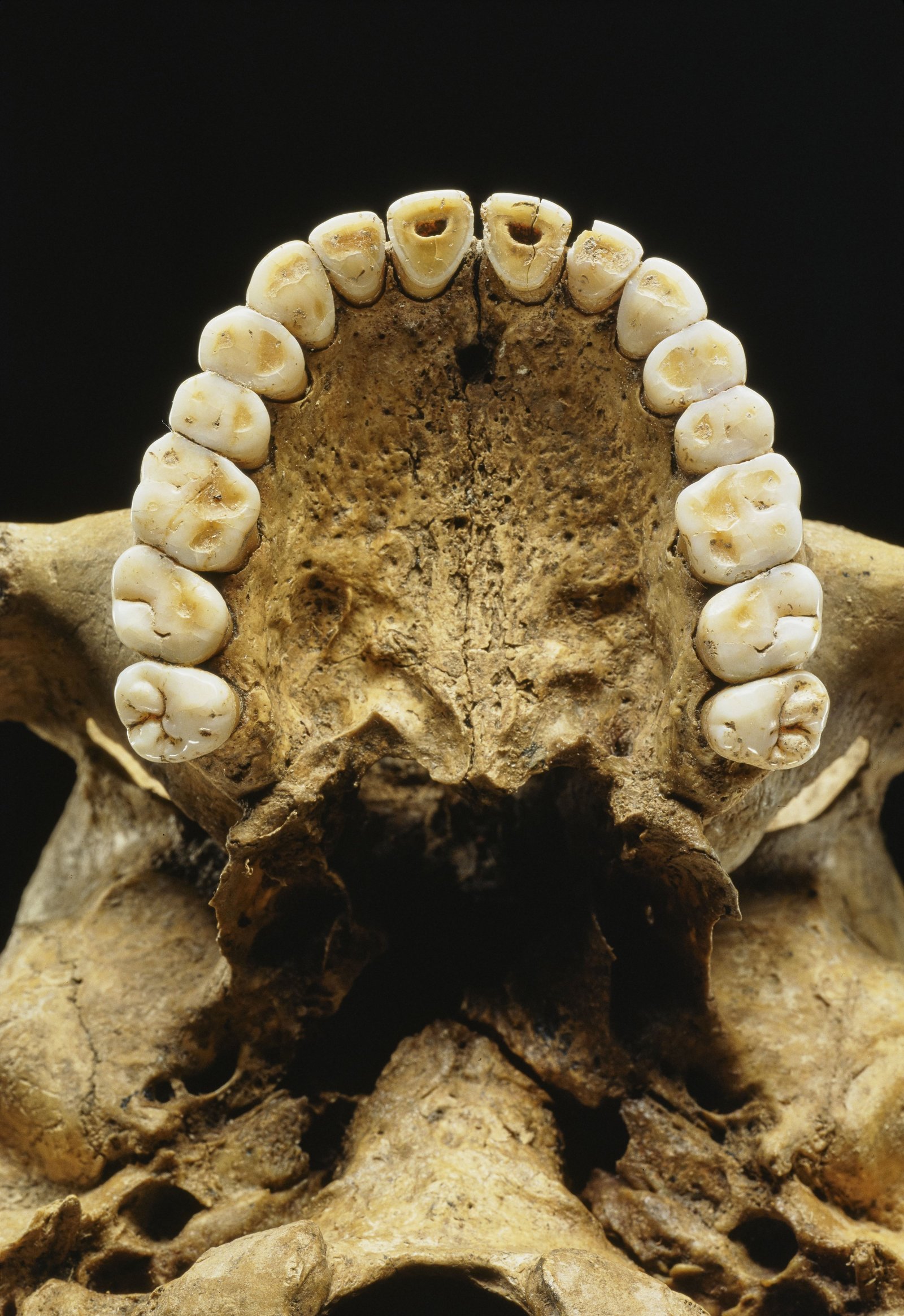
The pulp chamber of the upper front incisors are exposed due to severe wear – this must have happened rather quickly, as otherwise new dentin would have formed: was this the result of extremely heavy use of the teeth, or deliberate grinding as part of a ritual?
© LDA Sachsen-Anhalt, photo: Juraj Lipták
When it comes to the shamaness, it is really striking that she shows no skeletal changes at all, or at least hardly any skeletal changes that we would have expected at the age she has already reached. In fact, she also has very few prominent muscle attachment areas, not any at all, to be precise. Musculature is of course present, but it is not particularly pronounced.
If we compare this with people from the same period, i.e. from the Mesolithic era or, more generally, hunter-gatherers – whose lifestyle must of course be considered to be identical – we clearly see a very heavy strain on the lower extremities, because these people generally are very mobile and moved around a great deal. We don't see any of that in her at all. And this can actually be confirmed by measurements taken on her bones. She is indeed well below the normal average.
So she is someone who would be more likely to be found in a sedentary environment. And that is quite unusual, because we are still right in the middle of this era of the mobile lifestyle. That means she led a different life from that of other people of the same time.
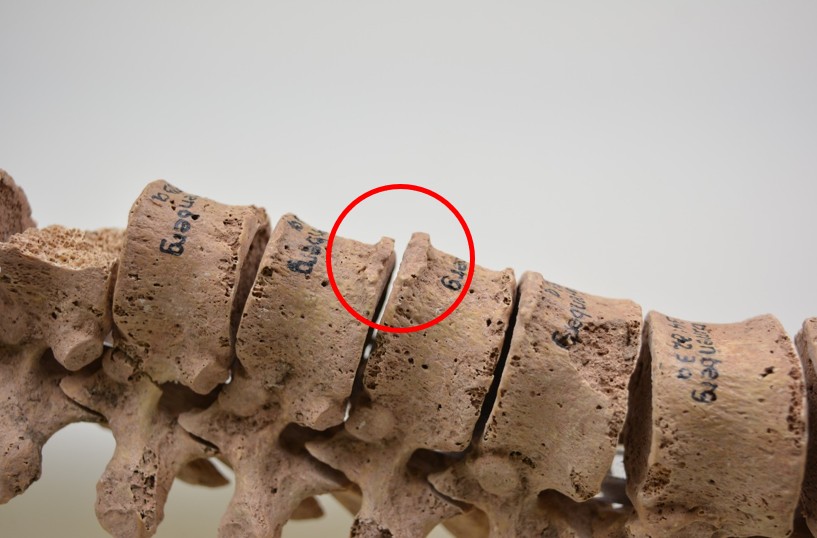
The wear and tear on the spine is not unusual for someone of her age. It could be the result of sitting with a hunched posture. This would correspond with the weak muscle insertion aswell as suggest an activity such as basket weaving.
© LDA Sachsen-Anhalt, photo: Jörg Orschiedt