Tortoise time
The fascinating thing about archaeological research is its continuous pursuit to find new ways decipher and reconstruct ways of life dating back thousands of years. For a long time, stone objects were largely overlooked. As the following analyses of the axe and the set of flint tools demonstrate – quite unjustly!
My name is Judith Berning. I work as a conservator of archaeological cultural heritage here at the museum since 2022. My main focus is actually on inorganic materials, but as a conservator I am also responsible for looking after exhibitions or artefacts in the collection.
During a work meeting in the run-up to this special exhibition, I learned more or less by chance about these many fragments, which are attributed to the european pond turtles and were found during the 2019 follow-up excavation in Bad Dürrenberg. And after I took my first look at the fragments and saw how many hundreds of small fragments there were and how many broken edges, it quickly sparked a certain ambition in me, but above all an interest in taking a closer look at the material and this type of find, i.e. the european pond turtle itself.
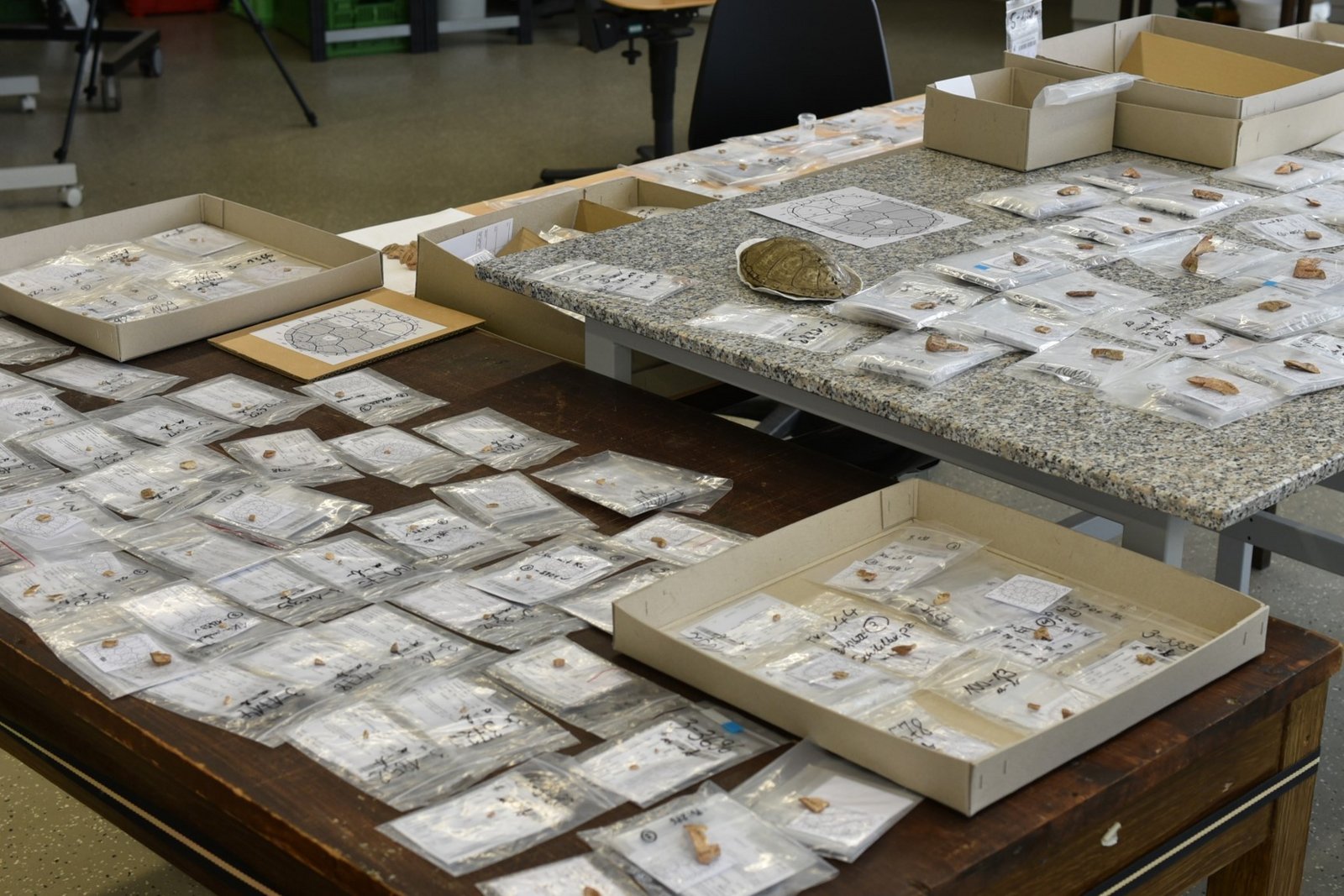
Display of a portion of the turtle finds. Each fragment is packed in its own bag and includes a separate, individually wrapped identification tag inside the bag.
© LDA Sachsen-Anhalt, photo: Judith Berning
For me personally, I think the main challenge was dealing with the European pond turtle as such, i.e. its shell structure, and understanding what the shell is made of and how the individual bone plates are assembled, as well as what the typical characteristics are that can be used to identify the individual bone plates. And to be able to detect these characteristics even in those very small fragments. You have to bear in mind that the shamaness's grave in Bad Dürrenberg did not contain complete turtle shells, but rather fragments of turtle shells, all of which came from the upper carapace. And this carapace is made up of many bony plates that have grown together over time. You can still see this today in the so-called bone sutures. No bones from extremities were found, nor any fragments from the plastron, but only from the carapace.
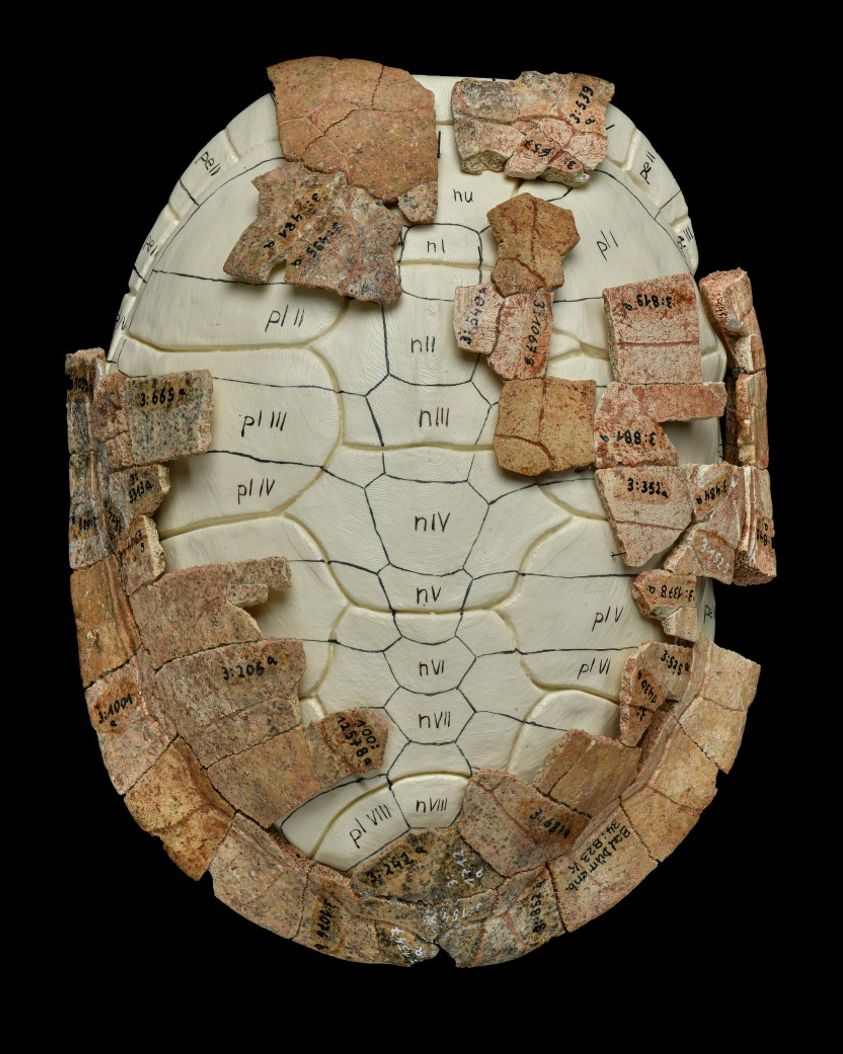
By fitting the fragments together, it was possible to assemble larger sections of the turtle carapaces. However, the placement of fragments without fitting is hypothetical and based solely on external characteristics (e.g. the size and texture of the bone plates). Here is an example of the reconstruction of Individual 4.
© LDA Sachsen-Anhalt, photo: Judith Berning
What really surprised me most was that there were still so many fittings. But above all, that there were so many fittings between the old and new finds. After all, the historic finds that were recovered in 1934, the turtle shell fragments, have been out of the ground for more than 90 years and now already have their own unique history as museum objects. They have gone through their own unique experiences, have in the meantime, in the past, been cleaned, some of them have been moulded, some of them have been reconstructed into shell models, and all that by applying methods and materials that we would no longer use in conservation today. And the fact that there are still fittings between these old and the new findings really amazed and surprised me. Which makes it all the more wonderful that the fragments have now found a conjoint place in the exhibition.