Flint tools in the grave
At first glance, the flint tools are certainly among the more unassuming objects in the grave. However, on closer inspection, they reveal fascinating insights into life in the Mesolithic period and contain a few surprises. Dr. Marcel Weiß has carried out a detailed examination of the artefacts made of flint, or silex like the material is otherwise known as.
My name is Marcel Weiß. I am an archaeologist here at the State Office for Heritage Management and Archaeology in Saxony-Anhalt at the State Museum of Prehistory, and I conduct research on the Palaeolithic and Mesolithic periods and deal with everything related to hunters and gatherers in our past.
Flint tools are important for researching prehistory because they are often the only surviving remnants, we have from perhaps two or more than two million years of human history. It's simply a material that lasts. And in some cases, we only have stone artefacts. Sometimes we also have wood preservation or animal bones or bones that can tell us even more. But ultimately, our mainstay are stone artefacts, because they are always the best preserved of all items. And one can learn a great deal about human behaviour and technology from stone artefacts.
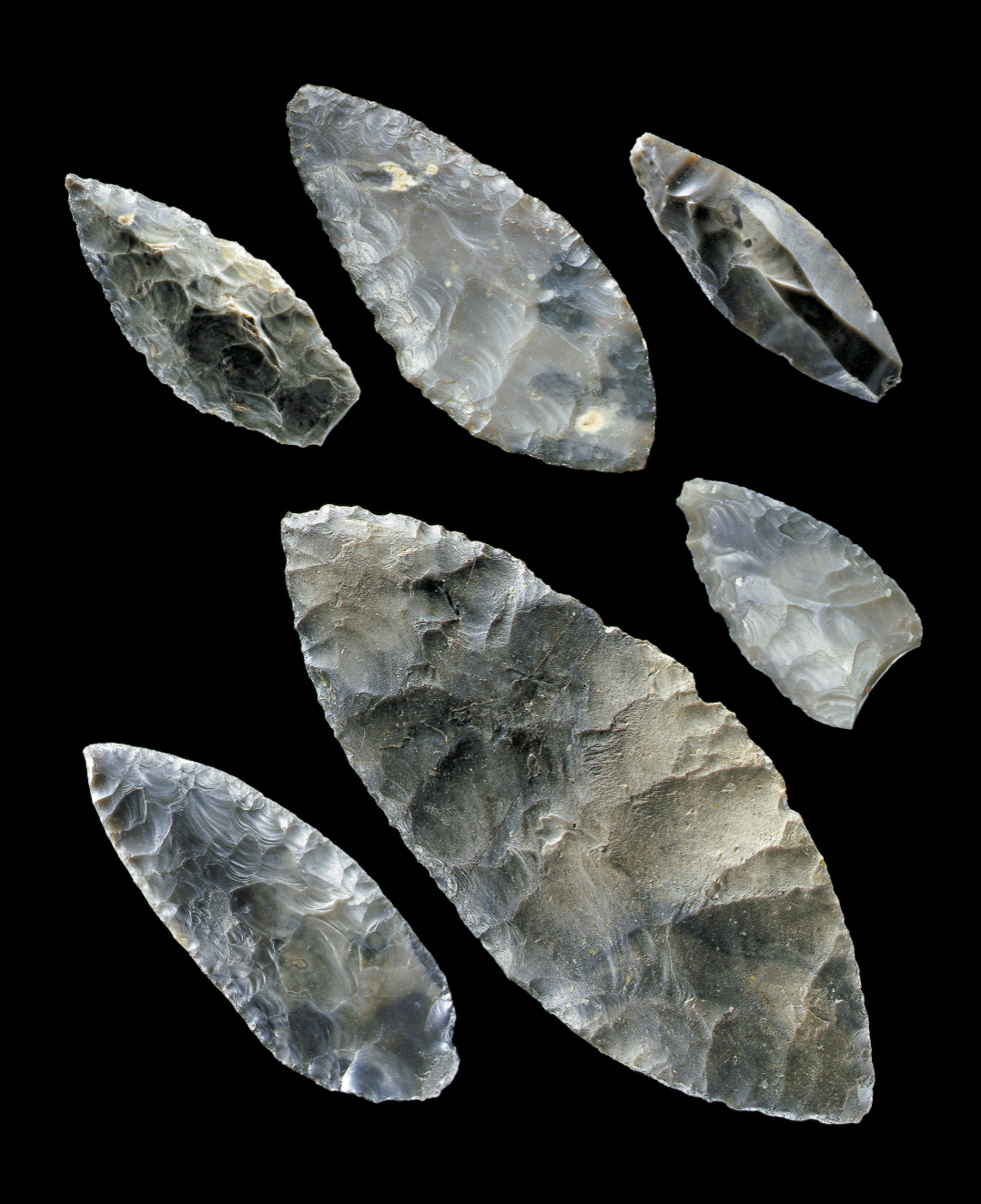
Flint has been the most important material for making precise tools and weapons for hundreds of thousands of years. These are the well-known blade tips from Ilsenhöhle near Ranis (Thuringia) – the longest of them is almost 20 cm long. They date back to around 45,000 years ago.
© LDA Sachsen-Anhalt, photo: Juraj Lipták
The special feature of Mesolithic flint tools is that they are actually very small – as the term microliths suggests. And the reason they are so small is because they were mostly used as arrowheads. And for this you had to make small basic shapes, i.e. small flakes and small blades. They were made even smaller and then used as inserts in arrows, because bow and arrow had increasingly become the main hunting weapon in the Mesolithic period... because it's all wooded, I hunt smaller animals, and it's just easier to shoot with a bow through the forest than with a spear.
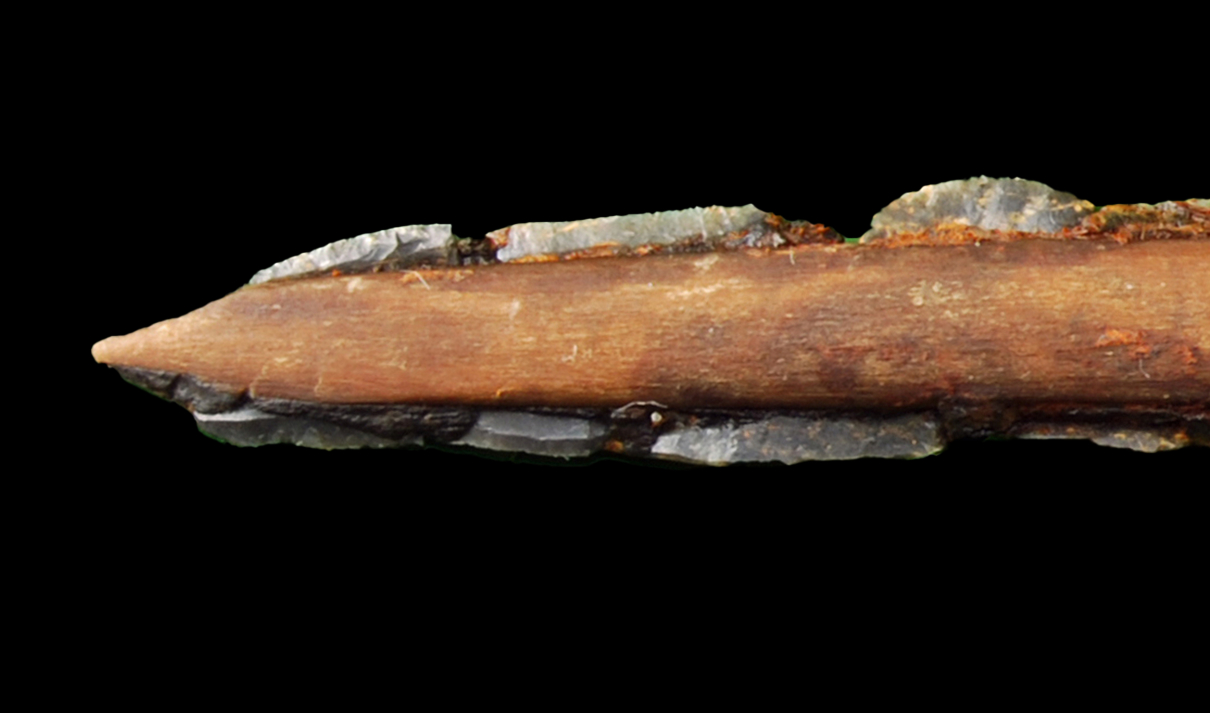
Close-up of the arrow from Motala, Sweden (5750–5550 BC). As seen here the microliths are glued in place with birch resin. This arrow can be seen on display in the final room of the exhibition.
© Fredrick Hallgren
If I now have a Mesolithic site that dates back to a time when I don't have any mixed inventory, I still have different microliths lying around. There is a reason for this. It is due to the fact that as arrow reinforcement, they are simply glued in different positions. And the microliths have yet another special feature. Namely, there are always shapes that look very similar. There are triangles, there are elongated shapes, there are segments, and this is a form of standardisation, so that I can replace the arrow reinforcement again and again.
The shamaness had a variety of flint tools with her in the grave. There are various blades and a few core stones that were lying in the grave pit or can be attributed based on the follow-up investigation. But the most significant find is actually the 27 microliths that we found inside a crane bone. This is a small container which held these microliths. They were already found during the 1934 excavation. And this is really a very special find because it is one of the few closed finds. That's what we archaeologists like to say when we can assume that these finds were deposited at the same time and are all related to each other. And what's even more fascinating is that you think, okay, they gave microliths to the burial for the afterlife so that she can build her own arrows. But the use-wear traces showed that they had all either been shafted, i.e. stuck to an arrow, or had been used. That means there are microliths from perhaps six arrows in there, all of which have been used before, but are still intact enough that they can actually be reused. And that is actually the most significant find in terms of stone artefacts that has been made in connection with the shamaness.
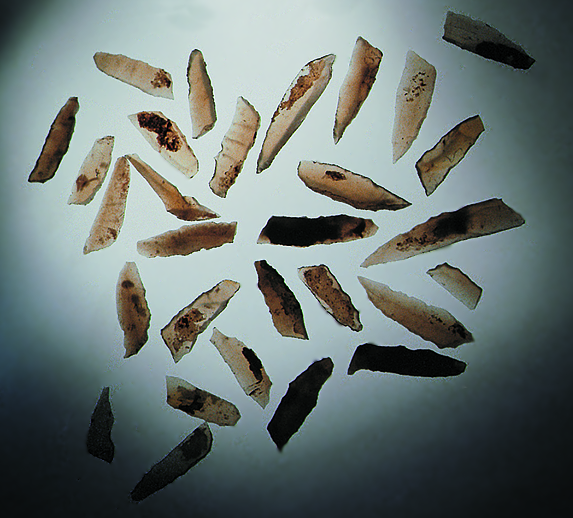
The microliths from the crane bone container.
© LDA Sachsen-Anhalt, photo: Juraj Lipták
The thing that fascinated me most was that the microliths that were submitted had already been used. Because that raises many questions. Why would you give someone something that has already been used?
And that ultimately suggests particular ideas that we can no longer comprehend today. But one knows that there is a very specific meaning attached to this for that period in time, namely that one passes on arrows or parts of arrows that have already been used. What this means can, of course, be interpreted in many ways. Are these arrows from different people? Were the meat offerings, contained in the grave, killed with them, or something like this? Well, you know... I find that quite fascinating, I must say.