Plaster of the Mesolithic age?!
Dr. Franziska Knoll is the head/coordinator/member of the research group and a specialist in everything to do with clay construction. This is not only because she initiated the ‘Gohlehm’ project, but also because she wrote her doctoral thesis on painted Iron Age wall plaster.
My name is Franziska Knoll, I am a trained archaeologist and am fortunate to work here at the LDA in research. I am involved in many projects, most of which have to do with construction technology, architecture, and building materials.
Well, the first thing I received was a small test tube containing plaster remains from the 1934 excavation, but it wasn't labelled as such. And when I unpacked them and held the first two pieces in my hand, they actually had an incredibly beautiful chalk lime surface, entirely smoothed and polished. And at first I was stunned, because I thought, that can't come from this grave pit. It looks like Roman lime plaster. What's it doing here?
Following on from this, we examined all the sediment remains from this entire re-excavation and, lo and behold, we found around 950 fragments that could also be attributed to this lime plaster, although most of them were not well preserved and only a few millimetres in size, with a total weight of less than a kilo. But we were still able to reconstruct a structure from this.
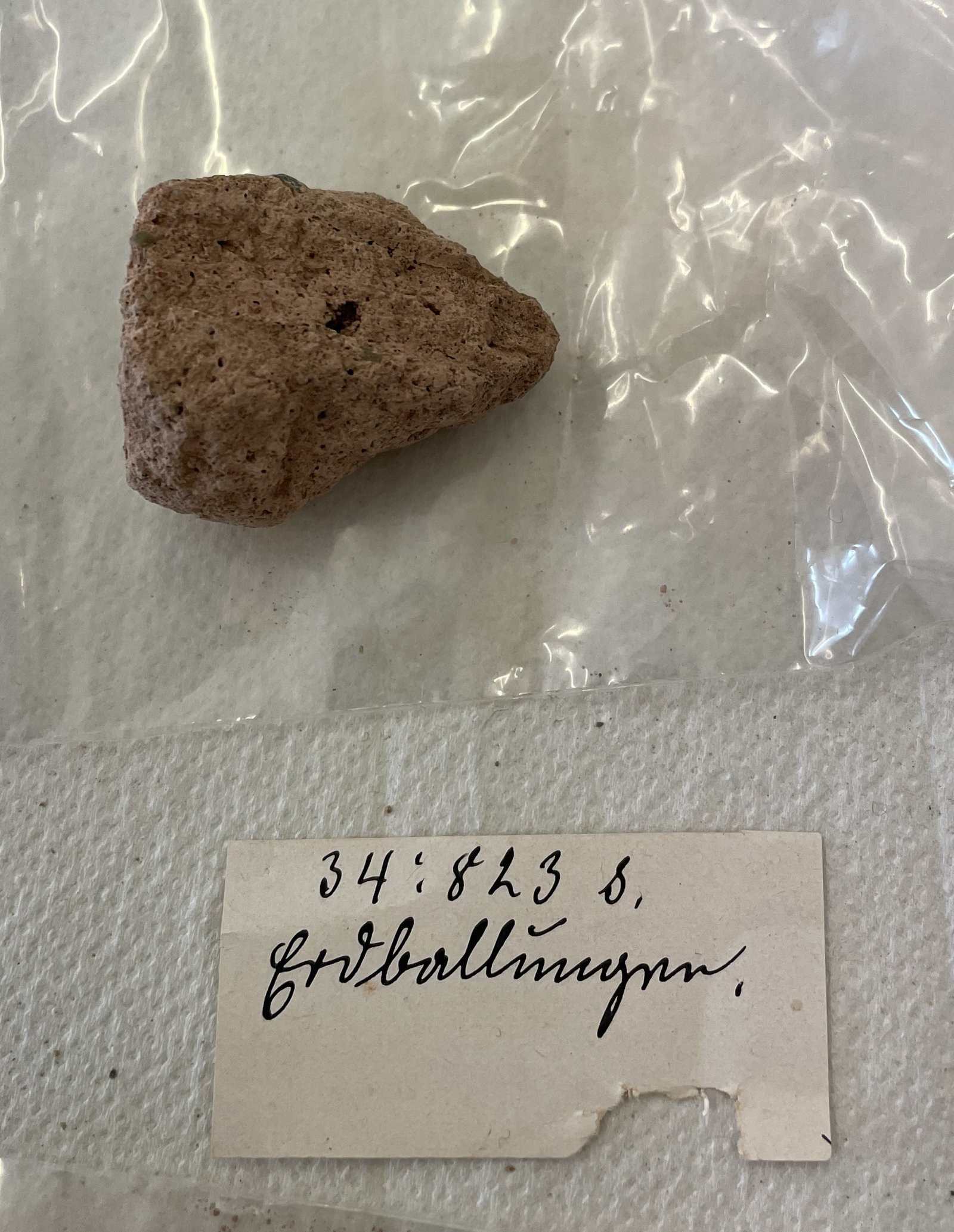
It wasn't until all the finds recovered in 1934 were re-examined that a few larger pieces, described as ‘clumps of earth,’ were noticed. When compared with the fragments from the exposed block excavation, these could also be attributed to the plaster remains. These fragments are the plaster remains.
© LDA Sachsen-Anhalt, photo: Franziska Knoll
The larger, well-preserved pieces of plaster had impressions of wattle on the back, i.e. wickerwork as we know it from half-timbered houses today, with a very smooth, beautiful surface. And that is something we would expect in house construction. But, as we all know, Mesolithic people are not actually sedentary; they may erect temporary structures, which they visit and renovate from time to time, but not something like this. Actually, we place this in the context of the Neolithic period, i.e. the first real settlers who established permanent settlements and built large longhouses. And they use exactly this construction technique, namely post structures, and they close the space between the posts with wattle, for example made of hazel rods, and then cover it with a very thick layer of plaster, but not lime plaster, rather clay plaster.
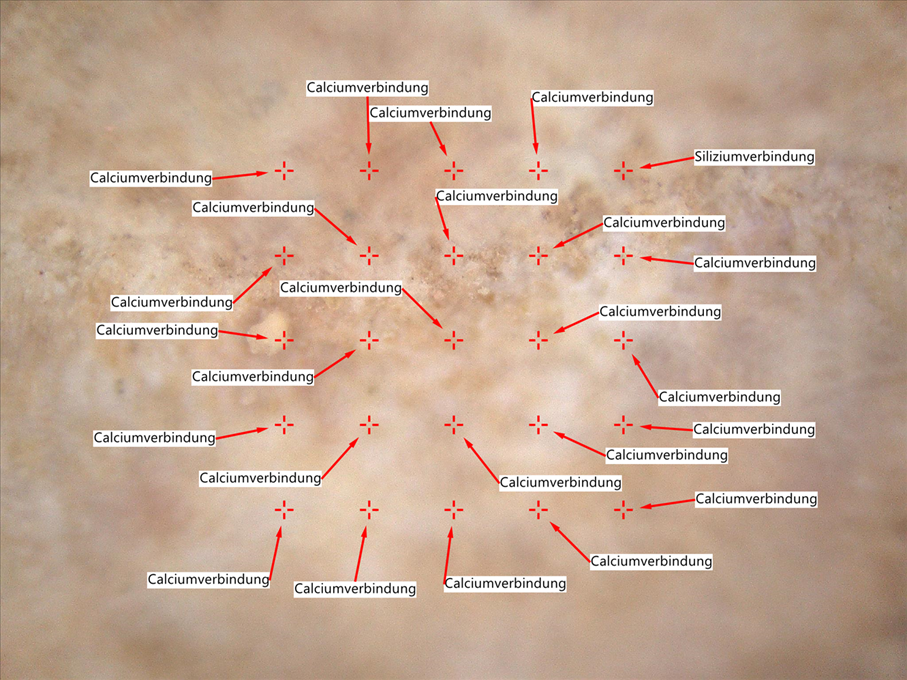
The remaining plaster was analysed at 25 points, arranged in a 5 x 5 grid, using laser-induced breakdown spectroscopy (LIBS) in order to determine the elements present. All samples showed a calcium compound with up to 16% Ca content, i.e. lime, as the base material.
© Christian-Heinrich Wunderlich, LDA Sachsen-Anhalt
Now that we have this finding, we really ought to start looking for Mesolithic buildings. After all, the technology is there, and they know exactly how to use the raw materials effectively. We now know they are hazel rods; we have proven this through pollen analysis.
Where are the houses to go with them? And, of course, they can have different structural designs. We are actually expecting to see a kind of sunken hut, but of course these must have walls, which must have some kind of rising wall construction, i.e. posts and wattle with plaster in between. Or even smaller, post-only structures where the interior is not sunken. And that is what we must now search for. However, this is somewhat difficult, because firstly, we have very, very few Mesolithic open-air sites. Secondly, the erosion is usually so severe that we can no longer find what we are actually looking for, because it is already gone.
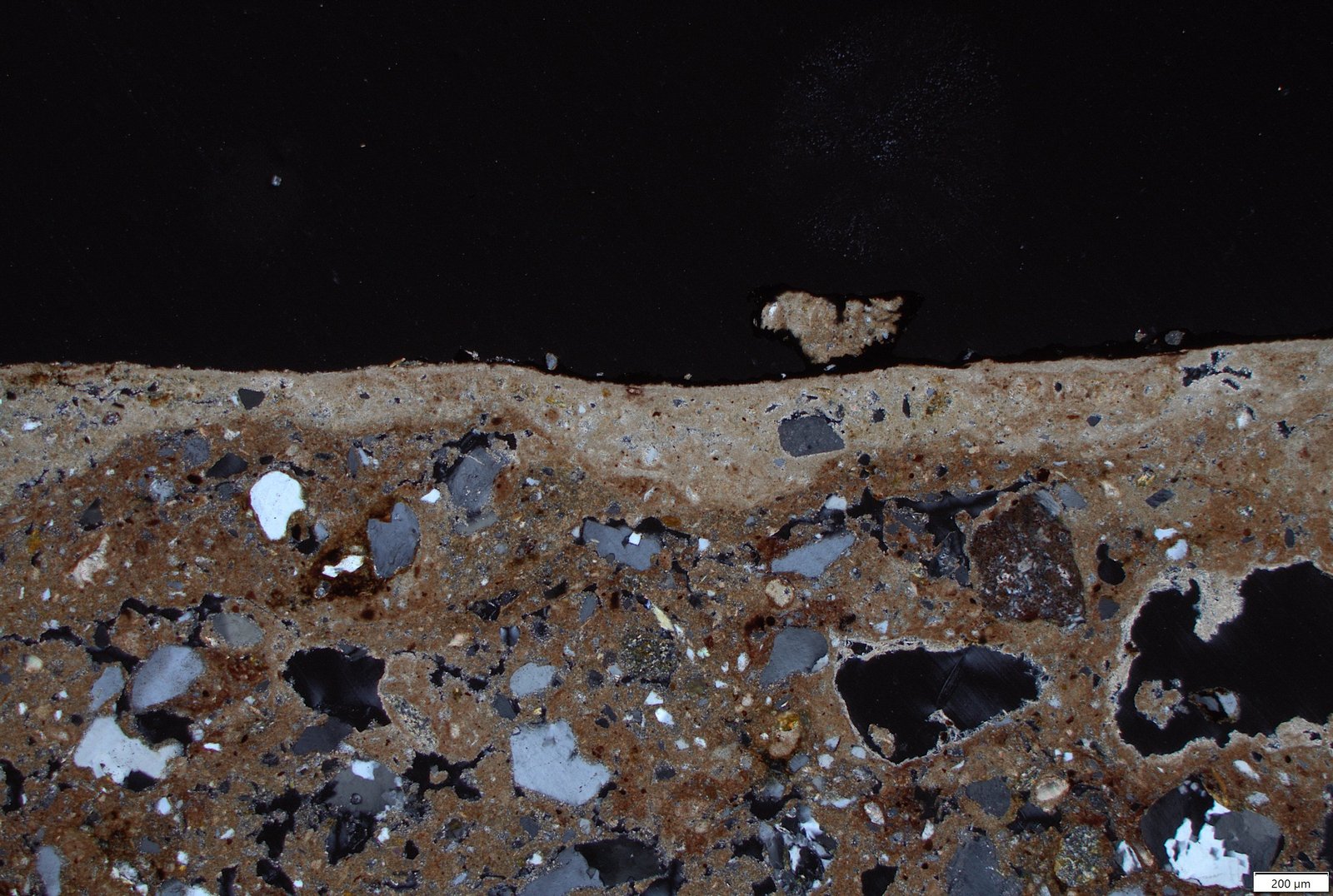
Ultrathin section cut through a fragment of plaster. Image taken using a polarising microscope with crossed polarisers (XPL). The compact, light-coloured top layer is only between 0.1 and 0.2 mm thick. It is probably a fine lime slurry.
© Mareike Stahlschmidt, Universität Wien/A. Röpke, Universität Köln