Miraculous Messengers
The search for pollen in prehistoric soil is astonishing – yet these microscopic pollen grains are extremely resilient due to their stable outer shell and can therefor survive for many millennia under favourable conditions. Dr Elisabeth Endtmann examined the grave of the shamaness for them and made remarkable discoveries.
Yes, my name is Elisabeth Endtmann. I am a biologist and work as a palynologist, i.e. a pollen analyst, at the Saxony-Anhalt State Office for Geology and Mining here in Halle.
With the help of pollen analysis, I can answer questions about both vegetation history and climate history. For example, whether it is rather cold or rather warm, whether the landscape is more open or already wooded. In an archaeological context, I can also tell whether the landscape was settled or not. And if all goes well, I can also date the items, so I have a temporal background for the deposits. There are very specific indicator species for very specific periods of settlement, and when I find them, I am relatively certain that I am investigating precisely that period.
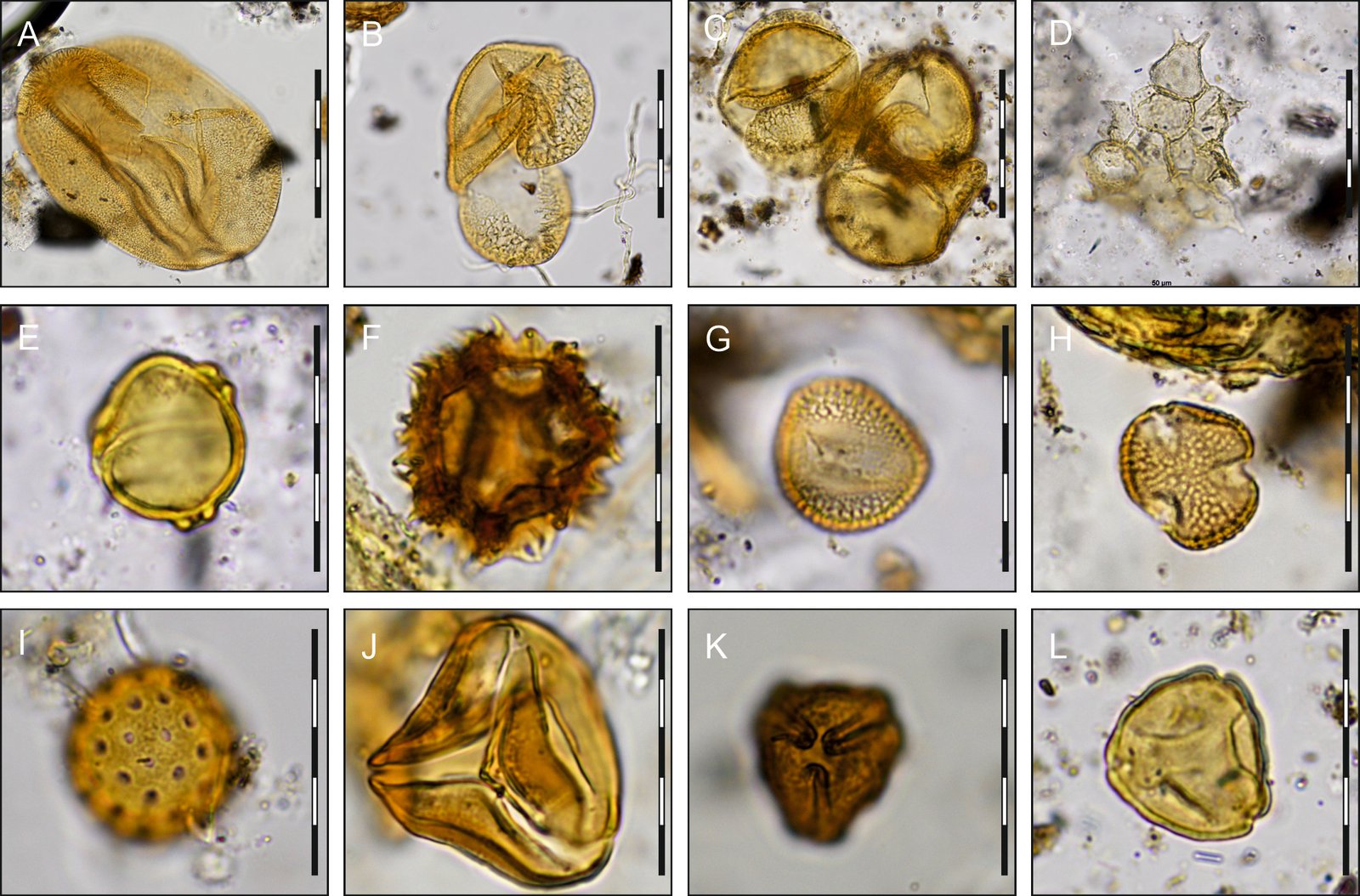
Examples of pollen from the Bad Dürrenberg grave: A Spruce, B–C Pine, D Green algae, E Birch, F Asteraceae, G–H Mullein, I Chenopodiaceae, J–L reworked pollen and spores of various types © State Office for Geology and Mining, Saxony-Anhalt, Elisabeth Endtmann
It really was quite difficult to extract pollen from there because the grave pit is a dry soil site. This means that the soil has been well aerated over many thousands of years. Pollen grains have a relatively complex structure and a very, very stable outer wall, known as the exine. This can be likened to the chitin skeleton found in insects. And that is highly resistant to many environmental influences. If I store the pollen in airtight conditions, under water in bog deposits, then they can be preserved for an incredibly long time, even millions of years. The only thing that devours these exines is oxygen. This means that much of the pollen material has been oxidised and destroyed. I must admit, I actually wanted to give up because the results were completely impossible to evaluate statistically. But it turned out that a little more pollen had been preserved in the area of the skull. These were, on the one hand, pollen from visually attractive flowering plants. And there were also, which was actually very, very exciting, green algae cell clusters. And that I had absolutely not expected at all, because they don't really belong in dry soil deposits. Ms Kirkinnen found micro-remnants of feathers from water birds, from geese, and I can well imagine that algae got caught in the plumage. These feathers then ended up in the grave somehow, and by a stroke of luck and coincidence, the green algae remained in the plumage.
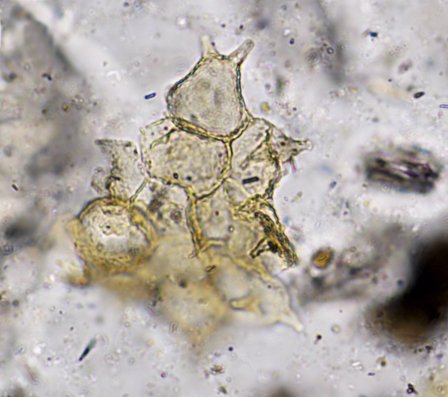
These clusters of green algae came as a great surprise. However, thanks to collaboration between various disciplines, a possible explanation for their presence was found. © State Office for Geology and Mining, Saxony-Anhalt, Elisabeth Endtmann
On the one hand, these were, as I said, pollen from visually attractive flowering plants. For example, mullein, but also buttercup, or meadowsweet. And excitingly, approximately 50 per cent of this pollen are pollen from plants that we know today as medicinal plants. I found that very interesting again. For example, buckthorn and birch are also popular today, and we found lady's mantle. These are always just individual pollens. In other words, no large features, but really just individual grains. But one can imagine that this might have a ritual background, that floral decoration might have been placed in the area of the skull. And regarding this – let's say – range of medicinal plants, it may be that this was a burial offering, although I personally tend to think that it somehow stuck to the hair or was preserved in the clothing.
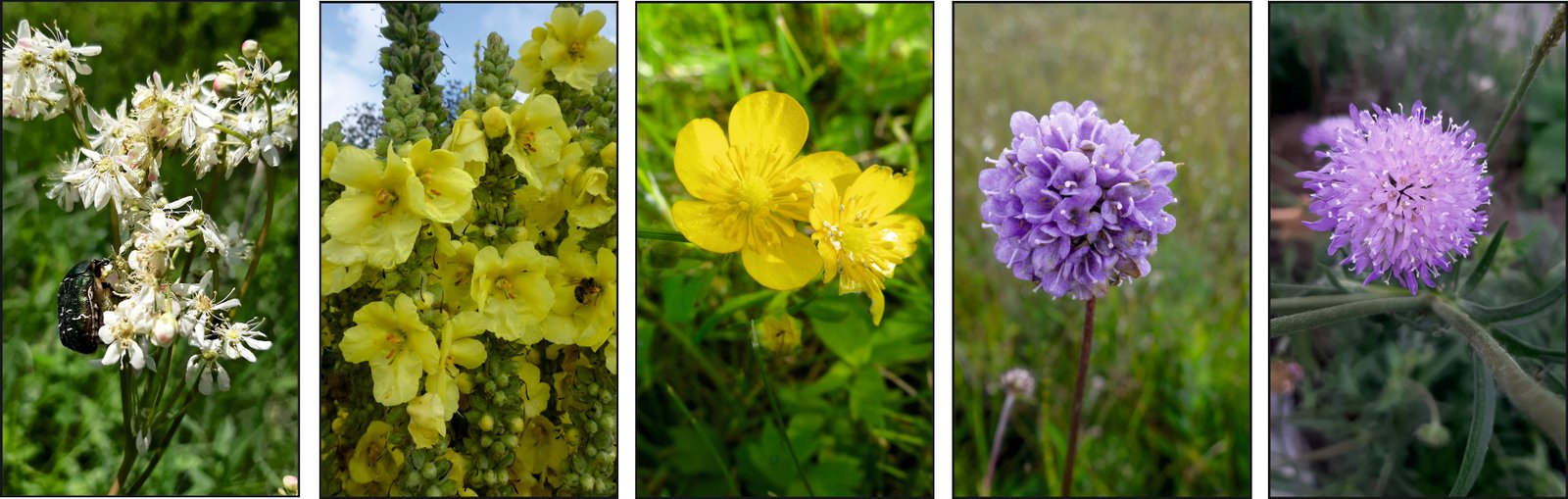
Possible floral decorations on the shaman’s head, from left to right: small meadowsweet, mullein, creeping buttercup, common devil’s-bit, dove’s scabious. © State Office for Geology and Mining, Saxony-Anhalt, Elisabeth Endtmann
Now, if you combine the flowering periods of these individual documented plants, you get a narrowing down to the summer months, possibly July. But even this is subject to many question marks, because we are describing a type of pollen that does not correspond one hundred per cent to exactly one species. However, around this time, during the summer months, July, we have the greatest overlap in the plants that come from the area of the skull.